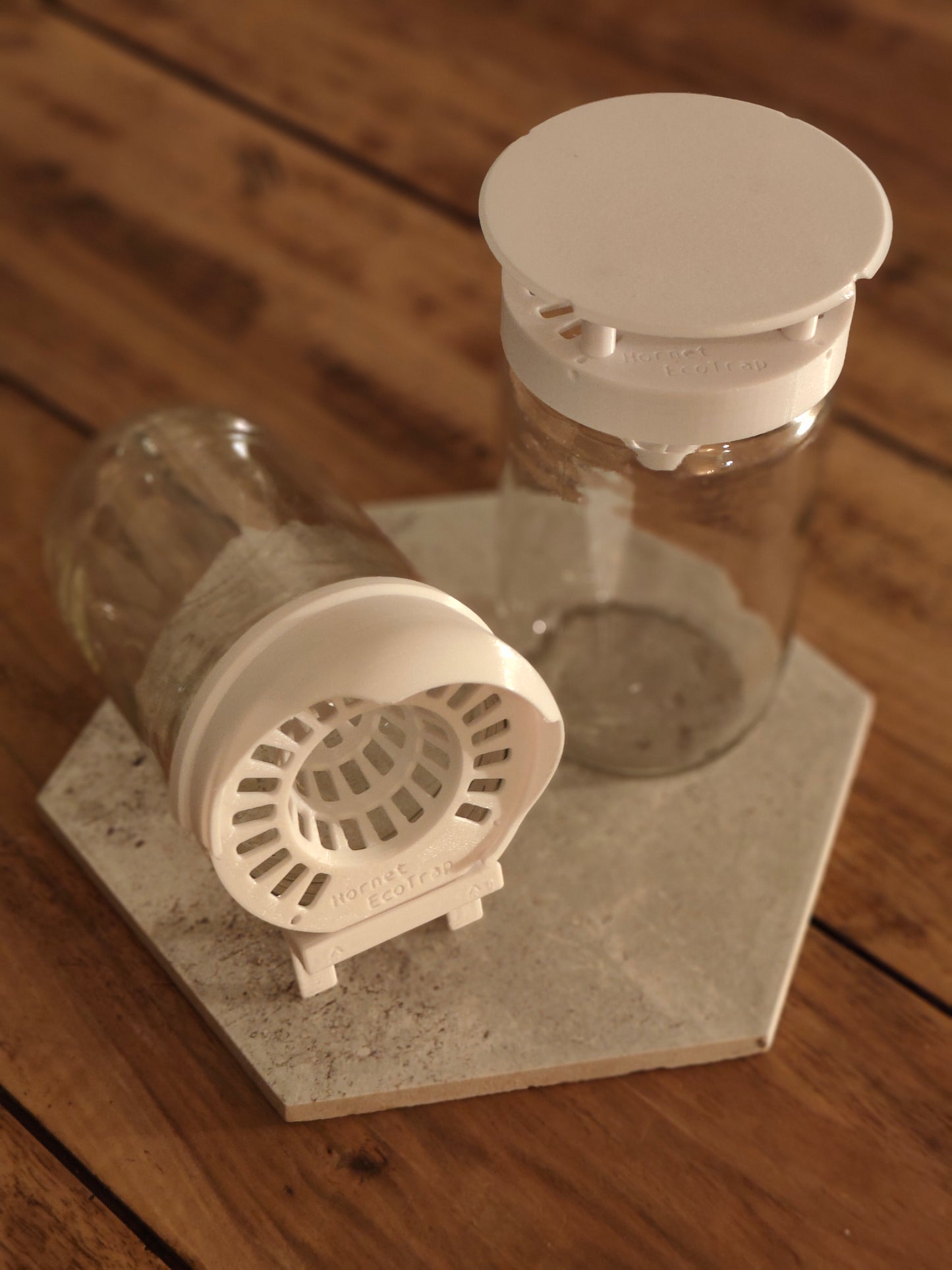
• Protects hives and gardens

    Faced with the expansion of the Asian hornet, trapping them is a good solution to protect hives and gardens. Reducing their presence brings back peace of mind.

  • Preserved biodiversity

    Designed to capture only Asian hornets, the Hornet EcoTrap works to protect biodiversity. Other insects can exit the trap.

  • Easy to use

    The Hornet EcoTrap can be set up in less than 5 minutes and is very easy to maintain. It fits most standard jars (8 cm diameter, TO 82)

1 of 3

Fighting Asian hornets

The Asian hornet is now emerging as a major threat to biodiversity and local ecosystems. To better combat it, we must understand what makes it a dangerous and incredibly adaptable species.

Nid de frelons asiatiques sous une charpente

An invasive species

The Asian hornet has virtually no natural predators in Europe. Its size, aggressive defense, and adaptability make it a formidable invader for bees and local biodiversity.

It develops rapidly, making human intervention essential to limit its spread.

A destructive species

The Asian hornet has a major impact on biodiversity . A formidable predator of bees and other insects, it disrupts pollination and weakens ecosystems.

Its presence leads to a decrease in pollinator populations , which are essential for plant reproduction, and thus endangers floral and agricultural diversity.

Order

A highly adaptable species

In addition to being invasive and destructive , the Asian hornet is also extremely adaptable . It establishes itself in both rural and urban environments, builds its nests in trees, attics, or under roofs, and easily acclimates to climate variations. This exceptional adaptability explains its rapid expansion throughout Europe.

Fight the Asian hornet with the Hornet EcoTrap trap

I protect my garden or my beehives.

Frequently asked questions

What is the Asian hornet and why is it dangerous?

The Asian hornet ( Vespa velutina ) is an invasive species native to Southeast Asia, introduced to Europe in the early 2000s. It is distinguished by its size (approximately 2-3 cm), its black-yellow body and its fast flight.

Biodiversity: it decimates bee colonies, reducing crop pollination.

Health: its stings can trigger strong allergic reactions, or even anaphylaxis in sensitive individuals.

Propagation: each queen founds a new colony every autumn, resulting in very rapid expansion.

In summary, the Asian hornet compromises agricultural production, biodiversity and, in some cases, public health, hence the importance of implementing effective control and capture measures.

I discovered an Asian hornet nest, what should I do?

If you discover an Asian hornet nest , never intervene yourself : these insects can be very aggressive.

Move away, note the location , then contact your local council or a specialist company for safe disposal.

⚠️ Do not attempt to burn it, drown it or move it: this is dangerous.

How to know if an asian hornet nest is empty?

In autumn and winter, all nests are empty and abandoned and will not be reused the following spring.

Each season, in spring and summer, new primary and secondary nests house a colony. The hornets’ back‑and‑forth flights indicate their presence.

How many Asian hornets are there in a nest?

The Asian hornet builds two nests per season.

The primary nest, formed in early spring, contains only a few dozen individuals.

When the colony starts to grow, the nest becomes too small and a secondary nest is built. This secondary nest will house several thousand hornets (typically 2,000 to 3,000).

What is the cost of destroying an Asian hornet nest?

The fees for destroying a hornet nest vary depending on your location and how easy it is to reach the nest.

Some municipalities or departments may cover the extermination costs, so check with your town hall.

If you need to hire a pest‑control professional, the price typically ranges from €100 to €200–€300. It can be considerably higher if access to the nest is difficult.

How can I get rid of Asian hornets?

The Asian hornet has no natural predators in Europe, so there is no natural regulation of its population, and its expansion threatens our ecosystems.

The only solution is to install traps to capture them.

When should an Asian hornet trap be installed?

Early spring (April‑May) – As soon as temperatures rise above 10 °C, queens emerge from hibernation and start founding new nests. Installing traps at this time catches the first workers that are looking to establish a nest.

Summer (June‑August) – This is the peak activity period for the Asian hornet. Keep the traps in place and refresh the bait whenever needed.

Late summer / early autumn (September) – The population begins to decline, but the last generations can still cause problems.

Winter (October‑November) – Activity drops dramatically. You can remove the traps or leave them (if not frozen) to prevent hornets from returning the following spring.

Practical tip: Position the traps at mid‑height (≈ 1.5 m), sheltered from wind, near a natural food source (fruit trees, flowering plants), and check them regularly.

How does the Hornet EcoTrap work?

The Hornet EcoTrap is a capture device specially designed for the Asian hornet (Vespa velutina).

The trap head features a narrow‑entry funnel. This design forces Asian hornets to enter the trap to reach the attractant, where they become trapped. The shape of the funnel and the size of the escape holes prevent them from getting out.

Beneficial insects (bees, butterflies, native wasps) can exit the trap.

What attractive mixture should I use in a hornet trap?

The most common attractant is a mixture:

  • 1/3 dry white wine
  • 1/3 grenadine or black‑currant syrup
  • 1/3 dark beer

Mix the three liquids in the trap’s reservoir. Replace the bait every 5–7 days or as soon as it shows signs of excessive fermentation.

Avoid synthetic chemical attractants—they are harmful to the environment. Always choose natural, biodegradable ingredients.

What is the best place to set up my trap?

1. Sheltered from wind – Place the trap near a wall, hedge, or fence. Strong wind disperses the attractant and reduces capture rates.

2. Mid‑height – Hang it about 1.5 m (≈5 ft) above the ground. Workers scout for nests at this height, and hornets are more active at mid‑level.

3. Near a natural food source – Position it close to fruit trees, nectar‑rich flowers, or areas where bees are already present. This increases the chance that hornets encounter the trap.

4. Away from frequented areas – Keep the device at least 5 m (≈16 ft) from patios, playgrounds, or house entrances to avoid accidental stings.

5. In a stable spot – Secure the trap to a pole, sturdy branch, or metal support so it doesn’t tip over in rain or wind.

By combining these criteria (shelter, height, proximity to food, and safety), you maximize the trap’s effectiveness while minimizing risks for people and animals nearby.

What is a Twist‑Off TO82 jar?

The Twist‑Off TO82 jar is a glass container intended for canning or sterilization.

The term TO82 refers to the size of the closure: a metal screw‑on cap with a 82 mm diameter that seals by a “twist‑off” (rotating) mechanism.

These jars come in various shapes and capacities. We recommend using a cylindrical jar with a minimum volume of 500 mL.

Does the trap work in rain or frost?

Yes, the trap remains functional in rain: the PETG body is water‑resistant and the sealed lid prevents excess water from entering. However, a prolonged heavy downpour can dilute the attractant, so you’ll need to refresh it.

In freezing conditions (temperatures ≤ 0 °C), the liquid inside freezes and the attractant becomes ineffective; the trap will no longer catch hornets until the ice melts.

Therefore, we recommend removing the trap or placing it under shelter when frost is expected.

How long does a trap remain effective?

A trap remains effective for 5 to 7 days as long as the attractant isn’t degraded. After that period, the mixture begins to ferment or dilute, which sharply reduces capture rates. To keep optimal performance, simply renew the bait every 5‑7 days; the trap itself (the PETG body) can be reused many times as long as it stays clean and intact.

How do I empty and clean the trap after a capture?

When the trap is full or the bait is exhausted:

Freezing method – Place the entire trap (jar + head) in the freezer for 30 to 40 minutes. The cold quickly kills the captured hornets.

Immersion method – Submerge the trap in a bucket of cold water until all the hornets are dead.

Cleaning

Rinse the jar very lightly, only to remove visible residue.

Avoid a thorough rinse; the remaining pheromone traces continue to attract hornets, thereby extending the trap’s effectiveness.

Where are Hornet EcoTrap traps designed and manufactured?

Our traps are designed in France, then 3‑D printed in local manufacturing workshops using PETG filament sourced from France. This close‑by production chain ensures traceability, reduces transportation distances, and supports the French economy. (The rain‑shield cap design is by Quante under a CC BY‑SA license)

Which countries do you ship to?

We deliver to homes in the following countries : Germany, Austria, Belgium, Spain, Italy, Luxembourg, Netherlands, Portugal