The seasonal cycle of an Asian hornet colony

The Asian hornet follows an annual life cycle, strongly dependent on the seasons and temperatures. Each year, a colony is born, develops, reproduces, and then dies as winter approaches. Understanding the Asian hornet's seasonal cycle allows for targeted and responsible action .

Key points to remember

  • A hornet colony has a lifespan of one year .
  • An uncaptured queen that spends the winter in a warm place is a future colony the following spring.
  • Early detection of nests reduces risks to humans and bees
  • Trapping in spring and autumn greatly limits the number of colonies

The overwintering of the queens (December to February)

During the winter, almost the entire Asian hornet colony naturally dies due to the cold and lack of food resources. Only the young, fertilized queens, also known as founding queens, survive , and their role is essential for the survival of the species.

Queen at the end of hibernation
Thierry Pierrard , CC BY-SA 4.0 , via Wikimedia Commons

They take refuge in sheltered areas: hollows and tree stumps, cracks in walls, piles of wood, attics... The queens then enter winter diapause until the following spring, a state of biological rest during which their metabolic activity is greatly slowed.

Each queen that survives the winter will be able to found a new colony of Asian hornets, which can quickly reach several thousand individuals if no preventive action is taken.

Colony foundation and primary nest (March to May)

As soon as outside temperatures exceed 10 to 12°C, the founding queen Asian hornets gradually emerge from their hibernation and resume their activity.

Primary Asian hornet nest
Francis ITHURBURU , CC BY-SA 3.0 , via Wikimedia Commons

Each queen begins the construction of her primary nest alone, a small and well-sheltered nest that will serve as the starting point for the future colony. This first nest consists of only a few cells.

Once the nest is established, the queen lays the first eggs and takes care of all the essential tasks herself: she feeds the larvae, maintains the nest and protects her offspring until the emergence of the first workers.

This phase is particularly strategic in the fight against the Asian hornet. Intervening at this time allows us to address the root of the problem. Destroying a primary nest or trapping a founding queen in the spring prevents the formation of an entire colony (ranging from a few hundred to several thousand individuals).

Development and expansion of the colony (June to August)

From the beginning of summer , when temperatures are consistently high and food resources are plentiful, the Asian hornet colony enters a phase of rapid and continuous growth .

The first worker bees emerge from the primary nest and gradually take over from the queen. They now perform the majority of tasks essential to the proper functioning of the colony: foraging, feeding the larvae, maintaining and enlarging the nest, and defending the colony and the nest.

Secondary nest
Fredciel , CC BY-SA 3.0 , via Wikimedia Commons

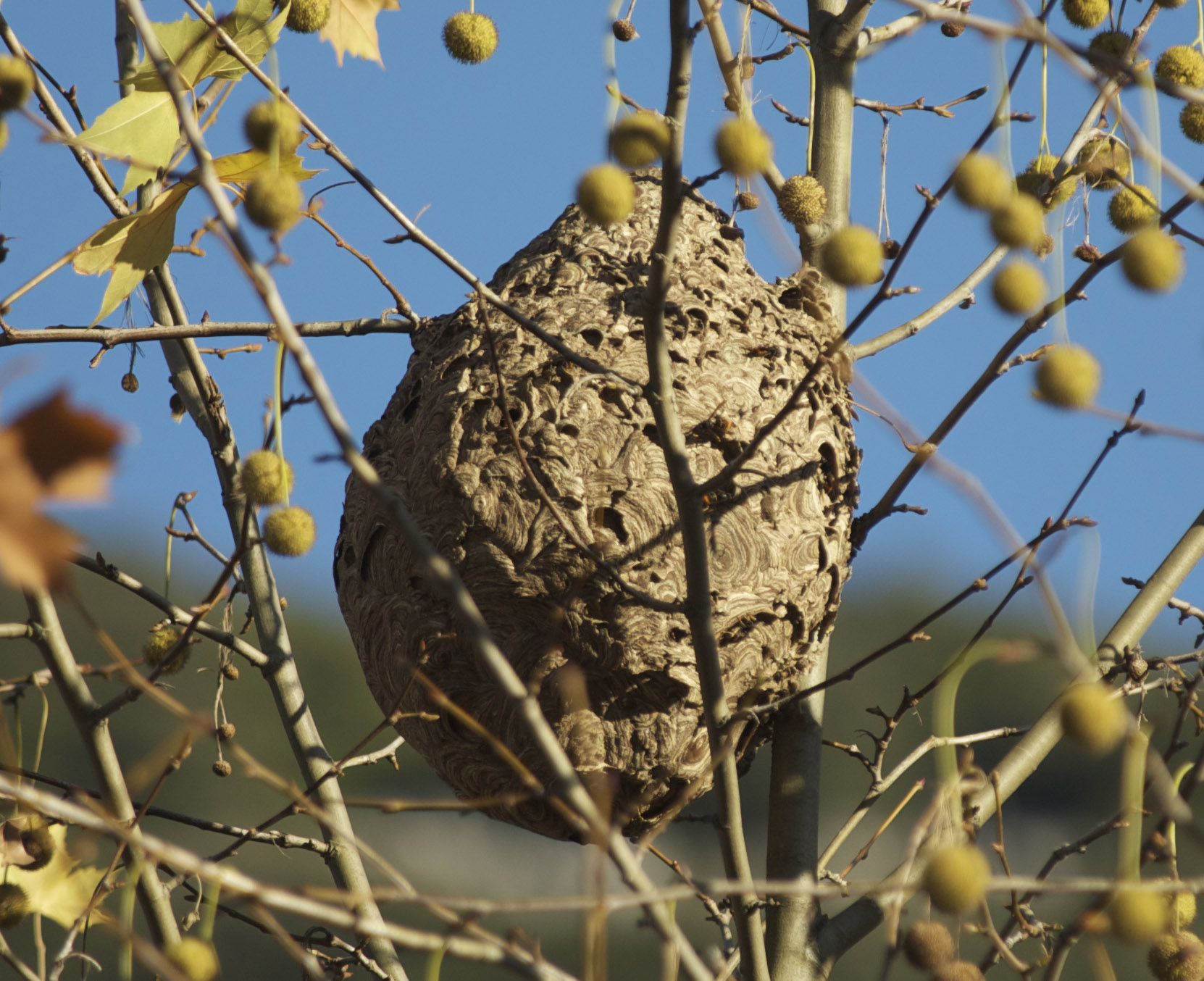
The primary nest quickly becomes too small to house the colony. It then migrates to a secondary nest , much larger, usually located higher up. These nests are frequently built in trees, at the edge of forests, on facades, under roofs, or on tall structures.

During this period, the Asian hornet's activity is at its peak . The worker hornets intensively hunt insects to feed the larvae, putting significant pressure on bee and pollinator populations. A colony can then number several thousand individuals, making any intervention particularly delicate and requiring the intervention of professionals.

Reproduction and end of cycle (September to November)

At the end of summer and the beginning of autumn , the Asian hornet colony enters its final biological phase, dedicated to reproduction and the perpetuation of the species.

The queen then begins to lay specific eggs that will give rise to males and future fertilizable queens. Mating takes place outside the nest.

After mating, the new queens leave the colony to search for a suitable site for their future hibernation. They must accumulate enough energy reserves to survive the winter and found a new colony the following spring.

As temperatures gradually drop , the colony naturally declines: the workers die one after another, the males quickly disappear, and the founding queen eventually dies as well. The nest is then completely abandoned and will never be reused the following year.

Our solutions for the selective trapping of the Asian hornet

Hornet EcoTrap selective traps allow you to capture founding queens before they establish a new colony in early spring.

Order my Hornet EcoTrap